



 Oops! We couldn’t find any results...
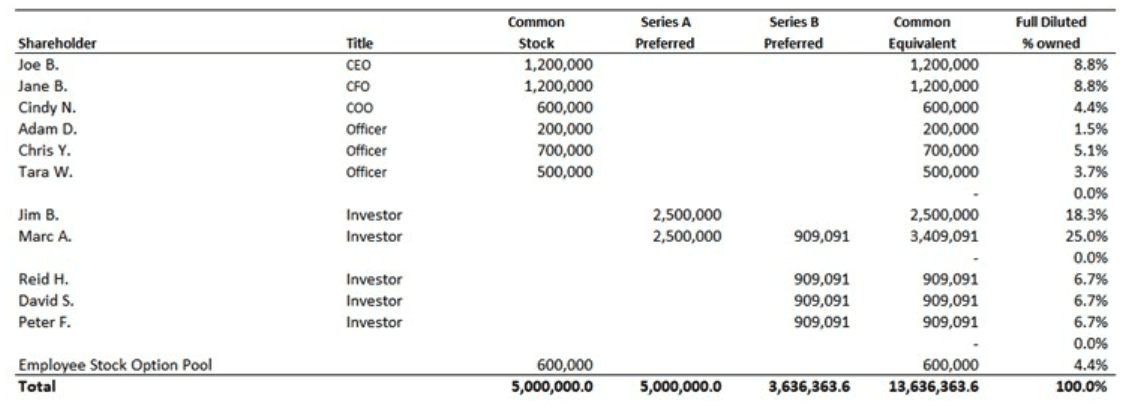
A capitalization table, also known as a cap table, is a complete list of everyone who holds equity in a company (and how much). This important document breaks down the amount of money each party has invested, how many shares they own and what type, and their stake (percentage) in the business as a whole.
Any time you invest in a startup, you’re joining that company’s cap table in some capacity. It’s important to get familiar with this document, especially if you’re investing larger amounts into a company.
This article will cover what a cap table is, how to read one, and exactly what makes this handy list so important.
What is a cap table?
A cap table is a spreadsheet detailing all of a company’s securities. These securities include common shares, preferred shares, and warrants; who owns them; and exactly how much each stakeholder paid for them.
How to use a cap table
Cap tables are used by venture capitalists (VCs), entrepreneurs, investment analysts, and investors to help them make critical financial decisions and assess a company’s market value. A cap table helps you discover things like:
How much of the business is still owned by the founding team
How much your potential stake in the company may be diluted in the next funding round
Who the primary stakeholders are in a company
Whether a startup uses stock options to incentivize employees–and how much
And much more.
Typically, the cap table is one of the first documents drafted up when a new company is formed. In most cases, it starts out pretty simple… for a bootstrapped startup, the initial cap table might only include the founders themselves.
However, as a company starts to raise capital from angels and VCs, make key hires using company stock as incentives, and give “sweat equity” to key partners and advisors, cap tables become much more complex.
In addition to recording transactions, a cap table also comprises many legal documents such as stock issuances, transfers, cancellations, conversion of debt to equity, and other documents.
Cap table example
Why are cap tables important?
Cap tables serve the critical function of outlining exactly who owns what in a business. As a startup progresses through funding rounds and grows into a large company, that list becomes longer and more complicated. It also becomes more important. Here’s why:
Cap tables show who’s in control of the company
There are many different ways for an individual or organization to get on a startup’s cap table. Some companies will give a few “points” to important advisors in exchange for their time and expertise. Many startups also offer new employees stock in the business as an incentive to join.
Most commonly, though, equity is purchased with capital from VCs and angel investors. When a venture capital firm invests in a startup, they typically buy preferred shares of the company. This is a type of stock that comes with special privileges, including (usually) voting rights or board seats in the company.
By looking at the cap table, you can see what people (or entities) have preferred shares in the company and thus, a say in all business decisions. Majority shareholders also have the power to approve or deny new funding and to vote to elect new board members.
This piece is critical; the Board of Directors is essentially a startup CEO’s boss. The directors can vote to remove a CEO if they feel it would benefit the company. Additionally, to sell a company, there must be a two-thirds majority of shareholders who vote in favor of the sale.
Cap tables outline ownership so investors know what to expect
Each time a startup raises a new round of capital, they’re giving up a little bit more of the company to those who invest. At first, that could mean a company’s founder going from being a 100% owner to a 75% owner (and giving 25% of the equity to investors). But in a startup’s later funding stages, the equity given to new investors comes from the whole pool—not just the founders.
In other words, if you invested in Startup XYZ, and then a year later that same startup raised more money at a higher valuation… unless you double down and invest again (also known as doing “pro rata”), your stake in the company will be diluted as other investors join the cap table.
Think about it this way: a pie can be cut into 4 slices or 40 slices, but there’s only so much total pie to be eaten. The same goes for equity in a startup. As more people come to the table, those slices get smaller.
By the time a startup has raised a few rounds of capital, its cap table might include several different kinds of stakeholders. Common types include:
The founding team
Board members and advisors
Angel investors
Venture capital firms
Company employees
Most startups also have an “option pool”—essentially, a repository of company stock reserved for future employees. Offering equity to new hires is one of the most common and effective ways for an early-stage business to attract quality talent, so it’s important for those companies to keep some stock locked away for that purpose.
Still, any shareholder in a company will want to know how their stake is doing over time. Using an up-to-date cap table, stakeholders can easily determine what their piece of the pie is worth as the company grows and raises capital at higher valuations.
How do SAFEs, convertible notes, and convertible debt factor in?
If you’ve ever invested in a startup on a platform like Republic, you’ve probably encountered security types that are a bit more nuanced than simple stock.
SAFEs and convertible notes (or convertible debt) are some of the most common types of securities offered via equity crowdfunding today. While they do differ slightly, they share the same basic characteristics. SAFEs and convertible notes are basically contracts entitling the investor to stock in the company–but only if and when a predetermined “trigger event” takes place.
Examples of trigger events may include fundraising rounds at higher valuations than the one the SAFE was signed at, acquisitions and mergers, IPOs, and more.
Before such trigger events occur, SAFEs and convertible notes are not actual, owned equity. As such, they may or may not be included on a company’s cap table. However, these documents are legally binding, so if a positive trigger event does occur, they should convert to equity and appear on the table too.
Final thoughts
When it comes to privately-held companies, the cap table is an incredibly important document to understand. Not only do they outline the overall ownership of a company… they’re also useful tools for determining potential growth, understanding dilution, and much more.
They can also be a great way for investors to see how they fit into the “bigger picture” of a startup’s history and backers. It’s almost like having a built-in network of co-investors (and who wouldn’t want to be able to say they’re “on a cap table” with a super-famous VC or angel investor?).
Any time an investor buys equity in a startup, they officially become part of that cap table in one way or another and, as a result, they become part of that startup’s story, too.
Interested in joining a company’s cap table?